Showing posts with label Mystery. Show all posts

Saturday, May 12, 2012

妙 & 間 (Myō & Ma.)

  
Good Ink, Fukuoka.

Dear Diary,
I recently returned back from Japan.
I performed 453 shows in four cities there. Our 3000 seat big top was usually full.
I joined and trained in Iaido in four separate dojos.
I was there for the earthquake.
And the cherry blossoms. (twice.)
I got lost. (a lot.)           
It was Myō.

A hundred years ago people wrote diaries. Your diary was your Facebook, your private audience, yourself. I suppose blogs and such serve that function now. This is how we label and describe our experience. I was looking for a way to describe the experience of spending a year and a half in Japan and I stumbled across the perfect word:


This word has two meanings.
It means indescribably beautiful.
It also means strange.
Myō.

So as far as meaning is concerned this word is an acrobat.
This word is doing the splits.
This is a Buster Keaton word; one foot on dry land, the other on the deck of the good ship Damfino as it bobs further and further from the shore.
And it is this duality that makes this word the perfect description of my experience in Japan.


Words can do a disservice to the actual. Our need to describe beautiful things can rob them of their beauty. 

Why can't we just shut up and let their silence do the talking?

So the Japanese invented a word that describes the indescribable. But this word is like a coin. 

Another meaning lurks like a doppelganger on the flip side of this coin.
And that meaning is simply this:
Strange.
Me and my Doppleganger
Indescribably beautiful on the one hand and just plain strange on the other.


Uttering the Unutterable
Sad Cookie Box.


I won't do my experience the disservice of description.

I won't try to label the appreciation I have for the placement of the delicately balanced foot paths I found on mountain trails.


I won't endeavor to put into words the tenderness I felt for a trio of monks as they quietly swept spent ginkgo leaves into a pile at some Kyoto temple.


I won't sully with syllables the rush of the marvelous that I felt seeing how a single well placed chopstick can take a cascade of hair spilling across a porcelain shoulder and turn it into an exquisite black whirlpool that rests atop a head like a finely woven nest.

 Suffice it to say it is indescribably beautiful. 
Yet with that there is a strangeness.
Suffice it to say it is Myō.


Shades of Shinjuku

Bloom Shelter


Is it not strange that on the last train on a Friday night on the Yamanote line a man can drunkenly stagger into a crowded train, vomit, step back onto the platform before the doors can close forcing the crush of humanity to be forced to stand on the fresh spew in that impossibly confined space for as many stops as it takes to get them to their  destination and nobody says anything.

Busiest Intersection on Earth.

Is it not strange that during the cold season sometimes 30% of our audience were wearing surgical masks.
(Whether they wear them to protect themselves from others or to protect others from themselves I was never able to ascertain.)

Beware of Kappa.
A flower amongst the ruins.
Is it not strange to look around the busiest train station in the world and see no litter, no graffiti and thousands upon thousands of people negotiating their way around one another and nobody bumps.

And the reason nobody bumps is that Japanese culture comes replete with a fundamental sense of Ma.

Kids keeping Ma.


MA

Meoto Iwa.
Ma is something beyond a word. 
It is a concept. 
A thread woven through the fabric of existence.

And another word that straddles two meanings.
Ma is distance but it is also interval.
It is therefore time as well as space.
Ma is the emptiness between things.
It is the stillness that lives at the end and the beginning of all movement.
In music Ma is the space between the notes.
In art it is the areas in which there is no art so that the art may more readily be seen.

When Robert Rauchenberg erased a de Kooning he was playing with Ma.

 In martial arts it is space between the opponents but also the time necessary to attack or defend.

Because Ma is both time and space concurrently it can be charged with possibility.
Ma is more than negative space.
Ma is alive.

 Shiokawa Sensei and the Hakata Iai Study Group.

In Iaido you can see Ma at work quite clearly.
You can see it in the transitions, where the residue of what came before gets a chance to ebb and the fuse of what is to come gets lit.

 Maeda Sensei and godan Greg Robinson, Nagoya.

Iaidoka try to distinguish this space with a charged/not charged quality.
This all inclusive awareness that does not pick out any one thing in particular but rather endeavors to see all calmly is called Zanshin. 
Keeping zanshin while executing a waza or form in iaido is one of those scratch your head rub your belly conundrums that never gets old because it never gets easy.
It is an attempt to follow sword/saint Miyamoto Musashi's suggestion in his Book of Five Rings to have your outward aspect be the same in battle as it is during everyday life and the same in everyday life as it is in battle.

 Practicing Zenteki Gyakuto at Shiokawa Dojo.

Zanshin is elusive.
If you don't have it you're dead.
If you try too hard to get it you're dead.
But the combination of good zanshin and an innate sense of proper Ma can be deadly.
Working too hard on my Zanshin.

In any duel (on or off the "battlefield") it is the one who controls the Ma who is invariably the victor.

Ma is also a deeply personal thing.
How you manage Ma is as distinct to you as a fingerprint, as revealing as an x-ray and perhaps the only place in the highly codified practice of iaido where personal style can be subtly revealed.

Ma can be very real.
And Ma can disappear.

When a memory of stepping into a warm spring fed Onsen is as vivid as if it is happening right now that is the Ma of time collapsing.
And the very real six thousand miles between Tokyo and San Francisco is the Ma of distance rearing its ugly head.

Dear Diary,
I miss Japan.
It was really Myō.

Mixed messages in Miyajima.


Shiokawa Dojo photos by Remi Lemieux


Wednesday, December 28, 2011

Kabukified!


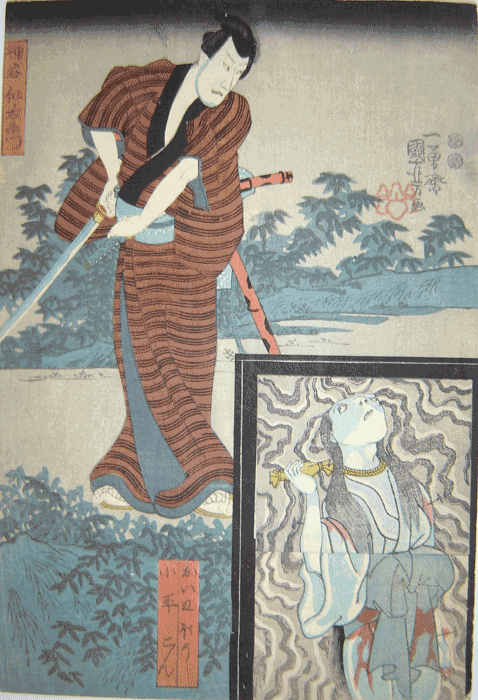
1794: Sharaku's famous depiction of actor Otani Oniji as Yakko Edobei, a villainous rogue who plots to steal money from the servant Ippei. Sharaku is known as a mysterious Ukiyoe master for he was only active for 10 months and his date of birth or when he died still remains unknown.


2011: Marie Kumamoto's version of me as the hair brained and harried House Manager in Kooza.


2011: Photo by Miron Rafajlovic.

Tuesday, July 26, 2011

Of Crickets, Flies, The Ghost of Oiwa and the Unexpected


Oiwa


It was night.


In a time before the intrusion of electricity on the narrow streets that still crisscross haphazardly around Yotsuya Temple in Edo era Tokyo.


Only the waxy glow of lanterns lit the narrow alleyway that led to the home of Iemon, a samurai whom the fates had blessed with the fatal combination of being both luckless and hot tempered.

Iemon has fallen in love with a beautiful girl, as beautiful as the goddess she had been named after, with a face as round and pale as the moon reflected upon a pond.


This was Oiwa.


Earlier in the evening Iemon had asked her father for her hand. The request was flatly refused. Oiwa's father had laughed at Iemon, calling the low born samurai an inconsequential ronin, unworthy of Oiwa in every way. Oiwa's father's friends had joined in the laughter and the incident was quickly brushed under the tatami.


And the lanterns flickered deep into the night.


But now it is many jars of sake later and Oiwa's father is making his way homeward when a figure congeals from the inky shadows, a heaving silhouette, the brushstrokes of his top knot in disarray against the oily lamplight.


"I ask you again for the hand of Oiwa."


Oiwa's father's snort is guttural, dismissive.

"Iemon. You again. Have you not seen the beauty of Oiwa? How could you even hope for my consent when you are nothing but an umbrella mender?"


Iemon's reply is a whisper of steel.


A glint in the lamplight later and Oiwa's father is halved, gurgling briefly from both sides of his bisected throat and then, from the darkness, there is silence.


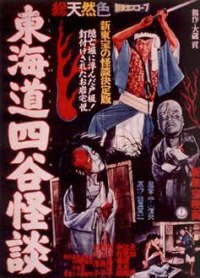
Thus begins the ghost story of Yotsuya Kaidan.

The tale of Oiwa.


Before it is over Iemon will have disposed of the father's body, married Oiwa, become enamored of a rich woman, poisoned Oiwa, killed his trusted servant, nailed them both to a door and pushed them down the river only to be haunted by the disfigured face of Oiwa as it rises from the lanterns and lashing out at it, he adds the rich woman to his list of victims. It is then that Oiwa finds her true calling as tormentor and eventually draws Iemon to his death one night in the black expanse at the edge of a jagged cliff, far beyond the lanterns' glow.


In my search for the mask of satori this is a cliff I wanted to dangle my toes over the edge of.


I am not alone.


No less than 35 movies have been made depicting the horrors that became of Iemon and Oiwa. Tatsuya Nakadai lent his haunted expression to the tale in 1959. To this day Japanese horror filmmakers visit and pay homage to the shrine of Oiwa to avoid the inevitable curse of delays and even serious injury that befall any production company that does not pay its respects before beginning filming.


Nakadai in Gates of Hell.

The kabuki play Tokaido Yotsuya Kaidan is another retelling of the story of Oiwa. In it there is a quick change device called the Toita gaeshi 戸板返しallowing the same actor to play both Oiwa and the dead servant Iemon has killed and nailed to the door with her.


Toita Gaeshi.


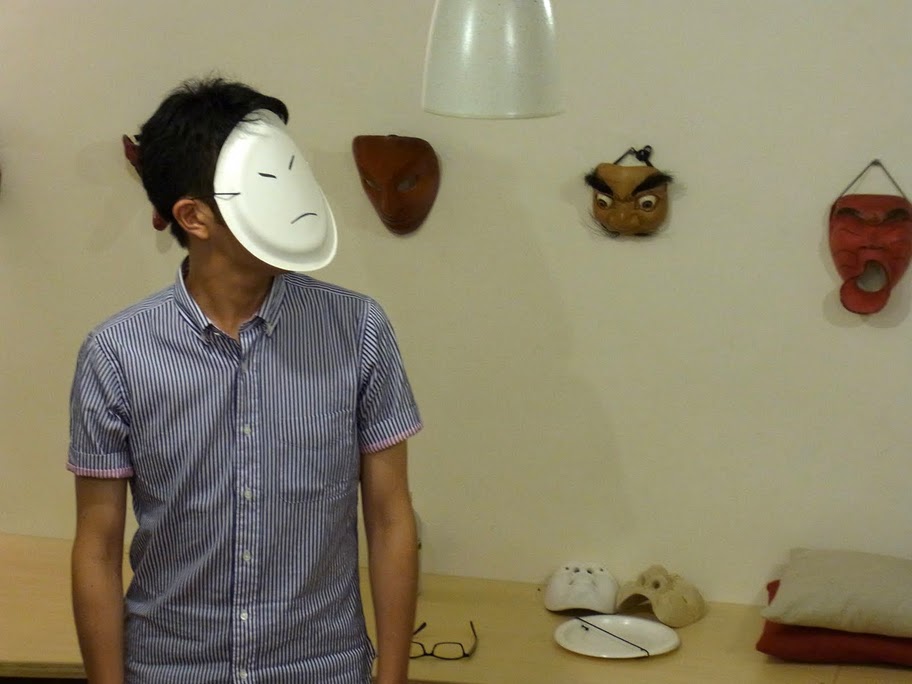
So in creating a mask whereby one actor could play both Oiwa and Iemon at the same time I tried to borrow that principle.

So my mask for Oiwa the Beauty is also the mask of Iemon's Avarice and ultimately the mask of what Oiwa would become.


Oiwa and Iemon in the Mirror


In Praise of Sorrows


Woven into all of these stories is a sadness the depths of which I had never witnessed before coming here.

There seems to be a kind of baseline thrum, a mean high tide line as it were, in which sadness rests firmly as the dominant chord.


Sadness as the norm.

Which makes a kind of sense.

For joy is, and must always be, the aberration.


Humor, laughter, excitement all thrive on the same fundamental ingredient: the unexpected.

Rob them of this crucial element and they fade back into the murk of the everyday.

Yet it is this grey tone of sadness that creates the necessary contrast to see all the many joys life has to offer.

Sadness is expectable.

Fun lives in the surprises.


His Name Is Norm.

Proud Tailbone


The understanding of this was illustrated most vividly in a recent workshop I gave on The Search for the Mask of Satori to a Japanese group called The New Expressionists. (More pics and vids here.)


Mind you, this was a joyful night. Aided by my many masks from Japan and Bali, Italy and France plus the talent of fellow clown Sean Kempton and the quick translation work of the wonderful Ryoko Ohtaki, the workshop was filled with laughs, some interesting what I call Juxtaposes and all forms of non-verbal communication. I think I may even have picked up a whole new dialect of body language in the process.


Contempt Plate

Bawdy Parts


The workshop was held in Taki San, our Kooza receptionist's hand made "One Kitchen" located deep in the tangled streets of Yotsuya, a short walk from Oiwa's shrine. (and former home.)


But back to Sadness.

In one particular exercise, which I have done with everything from seasoned professionals to inmates at a maximum security lock up for the criminally insane, involves half the group writing the names of various body parts on slips of paper while the other half writes emotions. I'm purposefully vague in my instructions, quickly saying "Happy, sad, angry or afraid, you know, something like that."


I usually get some interesting ones to work with especially when coupled with the body parts and people enjoy watching their fellow participants struggle with something like "Proud Tailbone" guy with a "Dangerous Chin."


But perhaps unsurprisingly given the underpinnings of the culture, of the fifteen or so emotion cards the Japanese participants had jotted down, nine of them were sadness.


And perhaps this is another form of protection, a lantern light at the edge of the abyss.


For sadness gives joy a place to arrive from.


Hand Sandwich.

Amber Waves of Disdain


Meanwhile I'm performing ten shows a week.

I am happy to report I am no longer killing a cricket.


In North America it made perfect sense (and got laughs) to kill (squash, mangle, smear, eat, snort, fall on, slip on, dance on, have tea with etc.) a cricket at the end of our mad cannon chase through the audience that culminates our 1st clown act in Kooza.


Alone on stage and keeping a wary eye on the cue light that signals me that the high wire contraption has successfully been put up during our high jinks, I would squash an imaginary if recalcitrant cricket to glean a couple laughs before exiting.

In Japan, where crickets are revered in haiku and kept as good luck charms by the elderly that did not fly.

It didn't even hop.


For weeks I could feel waves of disdain cross the footlights.

Finally I switched it to a fly. Flies apparently do not afford the same respect as the vaunted cricket.

And the warm, human, unexpected clown-in-trouble moments came back.


Sorting my yikes and disyikes.


Musashi and the Clown


Recently I've been catching the fly (initially) with my fingers like hashi (chopsticks) in a nod to the tale of Miyamoto Musashi dissuading some bandits at a roadside inn from thinking his disheveled appearance in any way reflected his zanshin (readiness/awareness) nor his skill.


While the bandits were planning what angle they would approach to rob him, he casually plucked out of the air and with lightening quickness the 3 flies that had been circling his bowl and laid them stunned but alive on the table side and continued his meal.


Maybe not the entire circus crowd under the big top gets the reference but enough do to get that little flash in the darkness.


The Unexpected.


Kooza pictures by Stephan M. Landry.
Workshop pictures by Masaki Tokutomi.

Thursday, April 21, 2011

Surreal Life


About Face


Andre Breton, in his Surrealist Manifesto published in 1924 described it as this:


SURREALISM, n. Psychic automatism in its pure state, by which one proposes to express -- verbally, by means of the written word, or in any other manner -- the actual functioning of thought. Dictated by the thought, in the absence of any control exercised by reason, exempt from any aesthetic or moral concern.


The “absence of control” part has had a special resonance on my Search For The Mask of Satori over the last month.


First there was the earthquake.


Very unlike the ones I have experienced in San Francisco and Los Angeles, this was a protracted sloshy affair that felt more like being on the deck of a ship than anything else.


I was even able to compose a poem during it. The font of the handwriting in my notebook can only be called Tokyo Earthquake.


Most of the artists and crew of Kooza were looking at each other with wide eyes and weird half smiles as the very ground we walked upon became this suddenly surreal landscape.


Of course the subsequent tsunami and nuclear disaster was unknown to us at the time.


3 days later, when news of these horrors started to come in and the constant aftershocks were busy jangling the nerves of some of my cohorts, many of whom are the most fearless humans I have ever known, Cirque du Soleil decided to evacuate us.


With about half an hours notice I was told to get my ass to Narita Airport. We were all going to Macau where we would be staying at the Venetian Hotel and Casino while they decided what to do with us.


This set into motion the crossing off of three items on my bucket list in quick succession:


  1. To run at full speed down a gangplank and dive into a plane as the doors are closing.

  2. To sit in 1st class.

  3. To catch a night ferry in the fog from Hong Kong to Macau.


Accidental Keinholz in Macau.


Twangly


The less said about the next nine days in the gilded, carpeted hell of the Venetian with its chlorinated canals amongst the constantly yelling Chinese vacationers with their annoying twangly voices and their razor sharp and ever ready elbows the better.


Surreal.


Suffice it to say we were glad to get out of there.


Arrivaderchi Macau.


Finally the word came down that we would be offered a plane ticket for anywhere in the world.


As long as we had an internet connection and could check in about seven days later to see whether we were to report back to Tokyo and that the show was to go on we could go anywhere.


Many chose to return to Tokyo. Many went back home to wherever it was they lived to see family and lick their wounds.

Some went to ports of call in Asia just to save money and be close.


I went to Paris.


Accidental Faces (Paris/Tokyo)


Accidental Ooooog.


Avid Reader.


Avid Eater.


If these cobblestones could speak...


Thank You, Cheeses!


Dreaming


I rented a flat on Rue Tholoze’, up a cobblestone street from Place de la Abbesses, a few doors away from where Tristan Tzara lived slightly less than a century earlier.


.

Neutral Mask. Not So Neutral Mask


My nights were about Jazz, Theatre and dancing at the Caveau de la Huchette. My days were museums and food. I visited the Catacombs. I ate many baguettes. I soaked in to the city and apparently it soaked into me a bit as well.

(Many times I was asked directions by tourists, so convincing was my manner. Eventually I would just tell them to fuck off, completing my disguise as typical Parisian.)


Jazz Chats Taking It To The Bridge.


Jazz Rats in the Caveau.


Man vs. Rodin


On the same alleyways and at the same cafes where Dali, De Chirico, Breton, Tanguy and Arp did their thing I scribbled poems and dreamed away.


Everyday Dream.


My wake up call was in the form of an email from Luc Trembley that Kooza would indeed be starting up again in Tokyo.


Three days later I was on a plane. Six days later I was performing again in Japanese for a sell out crowd in the Fuji Big Top.


Surreal.


Zen King


Le Poisson Soluble


Then, on a day off, I went with my fellow clowns and an acrobat to see the Surrealist Exhibition at the Tokyo National Gallery.


It felt like the set up for a joke: “Three clowns and an acrobat walk into a Surrealist exhibition.” but it was really quite thorough and we were all inspired by both the work and the thought behind it.

How do you depict with vigor and accuracy an inner landscape, a world that is ultimately undepictable?


“Beloved imagination, what I most like in you is your unsparing quality.”

-Andre Breton


Apparently Breton’s Surrealist Manifesto was written as an article for Le Poisson Soluble. And there in a glass case was an actual copy. Tangible, real.

Yet what it was attempting was to somehow catch the Poisson Soluble, The Dissolving Fish.


And what could be more elusive than a fish that dissolves!


Cadavres Exquis


We attempted a few Surrealist inspired Cadavres Exquis, or Exquisite Corpses the next couple of days and clown alley became a kind of little artist colony.


Joining us in this experiment was our resident pick pocket Pierre Ginet, who did not accompany us to the exhibition but who is, let’s face it, French.


"If Hearts Could Tell" by (in descending order) Ron Campbell, Colin Heath, Pierre Ginet, Sean Kempton

"Breathe" by (in descending order) Colin Heath, Sean Kempton, Pierre Ginet, Ron Campbell


Un Obliged


Things are seeming a little less surreal now as Tokyo gains its equilibrium but flashes of that fine madness do surface occasionally. And I still get that odd feeling, just after I flash my pass at the security gate at the big top that the guard is going to stop me. He is going to say:


“Summimasen Sir. This is not your life. You are not about to perform for hundreds of people. You can’t just walk in here with your coffee cup in hand and your Parisian jacket. You are dreaming, sir. You have to go back to real life.”


But he never does.

And I keep walking.


"It is not the fear of madness which will oblige us to leave the flag of imagination furled."
-Andre Breton

Trying to find a middle ground.