|
| Over the Moon at The Speakeasy (w/ Jon Deline) |
You find
yourself in a random street corner somewhere near the border of North Beach and
Chinatown in San Francisco. The smells of simmering garlic risotto and sizzling
Szechwan mingle in the evening air. You've been told to keep your eye out for
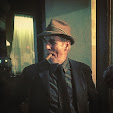
a fellow in a faded overcoat and a canary colored fedora. You see him slouched
insouciantly against a lamp post. He whispers a password to you past his down
turned brim and upturned collar, gestures with a granite jaw towards either a
Chinese laundry or a dusty clock shop. A goon at the door puts a hand the size
of a porterhouse steak against your chest.
"Password."
he grumbles.
"Skidoo."
you reply.
With a grunt
he lets you pass and you make your way down the rabbit hole.
You're in one
of two places: either Sam Lee's Laundry Emporium or Joe's Clock Shop. Let's say
you're in Joe's. The place is littered with clocks in various states of
disrepair on every available surface. A desk bristles with springs and cogs and
clock faces from every drawer. There's no Joe. Instead a dame in a sequined
dress that fits her curves in all the right places reclines on a bentwood
chair. Her gimlet eyes smolder at you.
"Are you
here to get a clock fixed?" she murmurs, lips painted the color of a day
old bloodstain.
"Not
really." you manage to stammer.
"Then
you've come to the right place." She purrs and gestures you with lacquered
nails towards a grandfather clock that probably last worked sometime around
1902.
You open the door that should contain the innards of the clock. That's when you hear it. Music. Ragtime. A honky tonk waltz. You step into the clock and out the other side...
You open the door that should contain the innards of the clock. That's when you hear it. Music. Ragtime. A honky tonk waltz. You step into the clock and out the other side...
And you are in
an illicit gambling den filled with flappers and dandies, swells and slatterns,
bootleggers and roustabouts all decked out in the full regalia of 1923. You
make your way past a Bellows boxing painting that hangs above a roulette table, past craps and
blackjack players hunched over the green felt of the gambling tables, their
chips clicking together in their sweaty palms and past an outstretched gloved
hand holding a long cigarette holder belonging to a women resplendent in spit
curls. Everyone is drinking.

A bookshelf
glides to one side on hidden wheels and you find yourself in a bar where a
mustachioed piano player named Oscar Frost plinks out some forgotten moonshine
sonata on a creaky upright. A bouncer with a face like a clenched fist and
tougher than the calluses on a barflies' elbow gives you a wink and sends you
through a secret passage marked only by a Dégas forgery. You make your way down
a long hallway. Still more music beckons you past a velvet curtain the color of
a bottomless lake.
You emerge into The Palace Theatre Cabaret, swollen with swells swilling in the sepia glow of their table lamps or spilling over the mezzanine above the bouquets of drunken boozers in the booths.
And onstage, caught in the glare of the footlights is a bevy of beauties in matching sequined hot pants kicking their long legs in perfect unison to the din of Mr. Arnie Topman and his Infamous Five.
In the center of the chorus girls a man in a top hat and tails sings. He's the master of ceremonies, an ever ready joker with a bucket full of clever asides in his brain pan, sporting a jet black wig and a powdered face. His name is Eddie. The song ends and he raises a flask in your direction, his lips inches from a 1923 vintage microphone and says in a voice redolent of that era "So glad you could make it. Welcome to The Speakeasy!"
 |
| Three swells swilling. |
Under
Construction.
It started
back in 2016 and even before that at another venue in 2014 and is the
brainchild of Mr. Nick Olivero of Boxcar Theatre and his peripatetic business
partner David Gluck. I was brought on to create the role of Eddie the Unlucky, the
irrepressible gadfly emcee of the cabaret (loosely based
on Eddie Cantor and a host of other comic luminaries of the Prohibition era) in their immersive theatre recreation of a 1923 speakeasy. I
had just emcee'd the Theatre Bay Area Theatre Awards at the Geary Theatre for
Nick and he asked if I was interested in creating Eddie for this 3 million dollar
project he was embarking on in San Francisco. The venue was still fully under
construction. It was a dusty, echo-y inhospitable environment to do theatre in.
Now, almost a year later it is one of the hottest tickets in the city. And
"Eddie" is at the center of it.

Becoming
Eddie.
First was
finding the material. Nick had done the heavy lifting of creating a cabaret
order of where the specialty acts, the chorus girls, the comedy vignettes, the
dream ballets would go. Eddie would be the one to tie them all together and
keep the ball rolling. The only rule: nothing written after 1923. Authentic
vaudeville humor. That plus what turned out to be seven songs, mostly from the
Eddie Cantor songbook; If You Knew Susie, The Dumber They Come, She Don't Like
It Not Much, etc. along with classics Lonesome Pine and even Those Were The
Days are sprinkled throughout the evening with patter and plain ol' stand up of
the time which needed to be part history lesson and part crowd control and all
funny all the time. That's not true. When things go awry Eddie waxes
philosophical and even holds forth with a Shakespeare soliloquy.
 |
| The Flannerelles. |
Luckily, Eddie
Cantor was an extraordinary source of wit and ribald humor for generations and
we were able to cobble together a kind of greatest hits and misses into Eddie's monologues from his vast body of work. And after a couple of months I started
thinking like Eddie. Seeing the world through his cockeyed eyes.
But then came
the physicality. There's plenty of footage available of Eddie in the 30's and
40's. (He was one of those rare ones that went from vaudeville to radio to
television without losing any of his well deserved popularity.) But there is
precious little of the work he was doing pre 1923. Just a few grainy kinescopes
and some scratchy audio.
My first clue
into him was his eyes. Throughout his career he affected a goggle eyed look,
eyebrows in a perpetual state of astonishment. Next came his hands, splayed and
fan like, as if the palms were capturing the limelight and the fingers were
directing it directly to his garrulous face. His hips were square, retaining
some of that early 20th century Puritan stiffness above feet that were like
mirrors of his inner state: lively, jivey and almost irrepressibly delighted at
everything he saw, heard or suspected might be on the horizon.

The interesting challenge was that he was small in stature. And that was part of his charm. And I wanted that. I wanted to cram his Napoleon complex into my 6' frame. I went to my favorite body part: the chin. By tucking it, while still letting my eyebrows have that Cantoresque buoyancy, I found I could feel like the world was a little bit bigger than me. Eddie is almost coy. But because he's got a trick or two up his sleeve, it's actually decoy. That along with a slightly oversized costume seems to do the trick.

Giggle Juice
and Tonsil Varnish
Since
developing the role, they've had 2 others playing Eddie in The Speakeasy
(including the aforementioned impresario Nick Olivero) but I like to think that
Eddie Cantor himself, up in front of those footlights in the sky, is looking
down with those big eyes of his and smiling, knowing we're all doing our best
to give the swell swells of 2017 a little glimpse into a time when girls had
gams, goons packed heat and giggle juice could get you daffy at The Speakeasy.
 |
| Eddie the Unlucky at the afterparty. |